
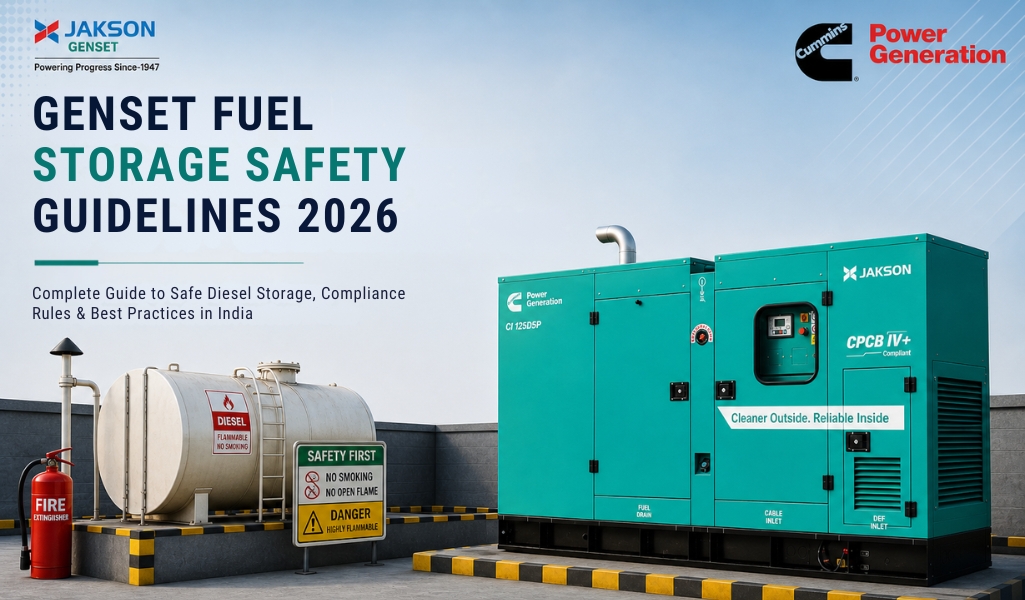
Most genset owners spend a lot of time thinking about their generator. The engine, the servicing, the load capacity. What they don’t spend nearly enough time thinking about is the diesel sitting in the tank behind it. And that’s honestly where a lot of the real risk lives. Store your fuel carelessly and you’re not just looking at a damaged engine. You’re looking at a fire hazard, a CPCB violation, and potentially a shutdown notice on your door.
With inspections getting stricter across India in 2026, here’s what you actually need to know.
The Part Nobody Talks About
Diesel seems harmless enough when you’re just pumping it into a tank. But it’s flammable, it degrades over time, and it behaves badly when stored in the wrong conditions. A tank that’s too full, poorly ventilated, or sitting in the wrong location isn’t just a compliance problem. It’s a genuinely dangerous situation waiting for the wrong moment.
Hospitals, data centres, factories, office buildings — they all run on backup power when the grid fails. And when fuel storage goes wrong in any of these places, the consequences go well beyond a tripped generator. That’s why the CPCB takes this seriously, and why you should too.
What CPCB Actually Requires in 2026
India’s Central Pollution Control Board governs diesel genset operation under the Environment (Protection) Rules, and those rules cover fuel storage just as much as they cover emissions. The current CPCB IV+ framework, which has been mandatory for new gensets since July 2023, sets out some clear requirements that every operator needs to follow.
Only use approved fuels
This one sounds obvious, but gets violated more than you’d expect. CPCB guidelines specify that only approved fuels can be used in compliant gensets. Most states now require Low Sulphur High Speed Diesel (LSHSD). If you’re running adulterated diesel or anything non-approved to cut costs, you’re not just damaging your engine. You’re putting your operating certificate at risk.
Know your day tank limit
If your genset is installed inside a building, your day tank, the one right next to or attached to the generator, cannot exceed 990 litres under fire and CPCB safety norms. Anything beyond that needs to go into a dedicated bulk storage facility that’s separate from the generator room entirely.
Bulk storage has its own rules
If you’re storing larger quantities of diesel on-site, your bulk tank needs to tick several boxes:
- Located safely away from the genset, electrical panels, and anything that produces heat or sparks
- Installed in a ventilated, fire-resistant structure
- Fitted with level indicators, overflow protection, and proper bunding that can contain at least 110% of the tank volume if something spills
- Clearly labelled with hazard signage
- Properly earthed to prevent static electricity from becoming an ignition source
Ventilation is non-negotiable
Diesel vapour in an enclosed space is not something you want to discover during a safety inspection. Generator rooms and fuel storage areas need adequate ventilation, whether forced or natural, to keep vapour concentration below dangerous levels. This is part of the CPCB enclosure compliance requirements and gets checked during audits.